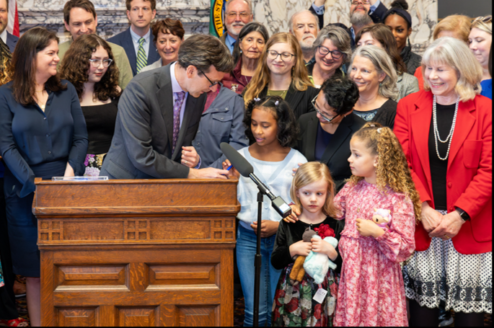
#1 Priority bill! Bottle and can recycling refund act – aka Bottle Bill (SB 5502 / HB 1607 – Concerning recycling and waste reduction): Championed by Senator Robinson and Representative Stonier, this bill would establish a system that facilitates the return of beverage containers, with a 10 cent refund. This bill is an Environmental Priorities Coalition priority bill for 2026. Read our factsheet here. STATUS (from 2025): Senate: By resolution, reintroduced and retained in present status. Moved to Rules White Sheet on January 12, 2026 House: Referred to Rules 2 Review on January 30, 2026. We understand the bill is designated NTIB.
Amending plastic bag law to ban all film plastic bags (SB 5965 / HB 2233 – Reducing environmental impacts associated with bags provided to customers at retail establishments): Championed by Representative Lisa Parshley and Sen. Jessica Bateman, this bill would amend the existing bag law to ban all film plastic bags at check-out and increase the fee for paper bags. STATUS: Senate: Passed to Rules Committee for second reading on February 23, 2026. We understand the bill is designated NTIB.
Post-consumer recycled content in additional products/packaging (SB 6156 / HB 2271 – Concerning postconsumer recycled content requirements for plastic products): Championed by Representative Liz Berry and Sen Lovelett, this bill would add additional product categories (rigid plastic items) and packaging categories (film) to the state’s existing postconsumer recycled content law. STATUS: Senate: First reading, referred to Environment, Energy & Technology on January 15, 2026. House: Referred to Rules 2 Review on February 7, 2026.
Expanding paint recycling program (HB 2301 – Concerning extended producer responsibility requirements associated with paint): Led by Rep. Peterson this bill would add more types of paint-related products to be collected and processed under the existing paint program, including paint thinner, paint remover, sealants, aerosol coatings, arts and crafts paint, and automotive, furniture and marine paint. Under the current program, residents bring their oil-based and latex paints to convenient collection sites available in rural and urban locations throughout the state. The paint is reused or recycled when possible. Requiring producers to be responsible for additional paint-related products is a good thing! However, these household hazardous wastes need to be collected and processed differently than latex and oil-based paint. We are working with the paint program representatives to strengthen the bill. STATUS: Referred to Rules 2 Review on February 9, 2026.
Bans DEHP in intravenous solution containers and tubes (HB 2402 – Concerning phthalates in medical equipment used for intravenous purposes): Led by Rep. Stonier, this bill would ban DEHP (a specific phthalate) in intravenous solution containers (by January 1, 2028) or intravenous tubing (by January 1, 2035). STATUS: Referred to Rules 2 Review on February 4, 2026.
EV battery recycling (SB 5586/ HB 1550 – Improving the end-of-life management of electric vehicle batteries): Championed by Sen Derek Stanford and Rep. Chipalo Street, this bill is modeled after NJ law (2024) and bills in CA, NM, CO and NV and sets up a system for ensuring safe recycling or repurposing of EV batteries. EV battery providers would be responsible for responsibly recycling their electric vehicle (EV) batteries to ensure beneficial use of the valuable resources in those batteries. They would be responsible for the cost of collecting and transporting EV batteries from auto recyclers, vehicle wreckers, and other persons with batteries that request the battery provider retrieve the battery. If a battery is significantly modified or used for another purpose, such as energy storage at a solar farm, the responsibility shifts. All entities must manage EV batteries in a manner consistent with a battery waste management hierarchy. STATUS: SENATE: By resolution, reintroduced and retained in present status on January 12, 2026. HOUSE: By resolution, reintroduced and retained in present status on January 12, 2026.
Textile producer responsibility (SB 6174 / HB 1420– Establishing producer responsibility for textiles): Championed by Rep. Reeves and Sen Lovelett, this bill would set up an extended producer responsibility program for apparel and textiles and restricts toxic PFAS chemicals in textile products. Textiles and fashion, especially fast fashion, harms the environment, waterways, increases carbon emissions, and generates a very large load of waste when people are ready to dispose of items. This bill is modeled after the bill that passed recently in California and emphasizes repair and reuse. STATUS: Senate: Heard in the Senate Committee on Environment, Energy & Technology at 8:00 AM on February 4, 2026. House: Public hearing in the House Committee on Appropriations at 10:30 AM on February 6, 2026.
Mattress recycling (SB 6271 / HG 2633 – Concerning mattress producer responsibility organizations): Championed by Senator Hunt and Rep. Hall, this bill would establish an extended producer responsibility bill for mattresses. STATUS: Senate: Heard in the Senate Committee on Environment, Energy & Technology at 8:00 AM on February 4, 2026. House: Referred to the Committee on Environment and Energy on January 22, 2026.
6ppd in tires (SB 6119 / HB 2421 – Concerning 6PPD and regrettable 6PPD substitutes in tires): Led by Sen. Liias and Rep. Hall, this bill would protect salmon and human health by phasing out 6PPD in tires by 2035 and by establishing a fee on vehicle tires to support a 6PPD mitigation fund. It would incentivize the industry to find and adopt safer solutions and prevents regrettable substitutes to 6PPD that are just as toxic or worse for salmon and people. STATUS: Senate: Heard in the Senate Committee on Environment, Energy & Technology at 1:30 PM on January 20, 2026. House: Referred to Rules 2 Review on February 9, 2026.
Environmental crimes (SB 5360 – Concerning environmental crimes): Championed by Sen. Trudeau, this bill would establish new crimes and provide penalties and exceptions, and reclassify existing crimes, for certain violations of the state Water Pollution Control Act, Clean Air Act, Hazardous Waste Management Act, and other specified provisions (environmental laws). It would also provide first-degree and second-degree felony violations for certain offenses under specified environmental laws in the state sentencing grid as seriousness level V and III offenses, respectively. In plain language: it would toughen penalties to make knowingly polluting in a way that puts another person in imminent danger a Class Be felony (instead of a misdemeanor), punishable by up to 10 years in prison and a fine of up to $20,000. STATUS: Senate: Passed off Senate floor (27-22-0-0) on February 17, 2026. In the House: Heard in the House Committee on Environment & Energy at 1:30 PM on February 23, 2026.
Cannabis packaging (SB 6303 – Concerning sustainability and safety in cannabis product packaging and vapor devices): Led by Sen. Shewmake, this bill would require the Liquor and Cannabis Board to adopt rules 1) to allow edible cannabis-infused products to be packed in one resealable child-resistant package rather than individual wrappings for each serving, 2) to allow cannabis concentrates and vapor products to be packaged and sold in unit sizes and and multi-unit packages that, in total, contain an amount of tetrahydrocannabinol or cannabis product that is not greater than the maximum quantity that may be sold or provided to a consumer in a single transaction rather than individually packaged 1-gram units currently required, 3) to allow digital batch-level identification methods for plant tracking rather than individual physical tags for each separate plant (which are plastic!), and 4) to allow return to retailer (in a secure, nonpublicly accessible container or receptacle) of open packages, used cannabis vapor devices, and used batteries from consumers for the purpose of recycling or safe disposal. The bill also requires that cannabis vapor devices sold in WA may only use batteries that are designed to be removable from the device. STATUS: Scheduled for executive session, but no action taken, in the Senate Committee on Labor & Commerce at 10:30 AM on February 3, 2026.
Filters for commercial/industrial washing machines (HB 2212 – Reducing microplastic pollution from washing machines): Led by Rep. Pollet, this bill would require installation of filters on commercial or industrial washing machines after July 1, 2028. STATUS: Executive session scheduled, but no action was taken in the House Committee on Environment & Energy at 1:30 PM on February 2, 2026.
Surplus computers to students (SB 6222 / HB 2432 – Supporting public school students by improving their access to surplus technology hardware): Led by Sen Hunt and Rep. Callan, this bill would allow school districts and educational service districts to sell surplus computer laptops, tablets, and other electronic devices or equipment at depreciated cost to public school students and to grant the hardware at no cost to public school students from low-income families (and they would be prioritized). This bill nicely complements last year’s Right to Repair bill! STATUS: Senate: Passed off Senate floor (49-0-0-0) on February 11, 2026. In the House: Rules Committee relieved of further consideration. Placed on second reading on March 2, 2026.
Reusable medical equipment – tax relief (HB 2175 – Exempting providers of free durable medical equipment from retail sales and use tax for certain items): Led by Rep. Klicker, this bill would exempt non-profit providers of free durable medical equipment from retail sales and use tax for items reasonably necessary for the operation of, and provision of health care by, those providers. STATUS: Referred to Rules 2 Review on February 4, 2026.
PFAS in pesticides (HB 2279 – Evaluating the use of PFAS chemicals in agriculture): Led by Rep. Parshley, this bill would establish a Dept of Agriculture program to evaluate the use of PFAS chemicals in fertilizers and pesticides. STATUS: Heard in the House Committee on Agriculture & Natural Resources at 10:30 AM on January 20, 2026.
Reparability of appliances (SB 6124 – Assessing the feasibility of developing an affordability index for appliances sold into Washington state): Led by Sen. Liias, this bill would require a Commerce study by January 31, 2028, assessing the feasibility of developing an affordability index for appliances sold into Washington state. The study must, at a minimum, consider what criteria an appliance would be evaluated under in an affordability index, including ease of maintenance and servicing, availability of repair materials including replacement parts, service manuals, and the need for special tools or proprietary software and more. STATUS: Heard in the Senate Committee on Ways & Means at 1:30 PM on February 6, 2026.
Farm to food banks (HB 2463 – Supporting Washington farmers feeding families): Led by Rep Reeves, this bill would make changes to Washington Commodities Donation Program, adding dairy products, modifying the qualifications of organizations that must be prioritized for grant funding under the program and establishing a farm-to-food pantry program to help nonprofit hunger relief organizations establish wholesale contracts for direct purchasing from local, small-scale farmers. STATUS: Executive action taken in the House Committee on Agriculture & Natural Resources at 8:00 AM on February 4, 2026.
Increase solid waste tax (HB 2018 – Concerning solid waste and establishing the local government solid waste assistance account): Led by Rep Doglio, this bill would increase the solid waste tax. STATUS: Heard in the House Committee on Finance at 1:30 PM on January 30, 2026. NTIB
Authorize local B&O taxes (HB 2097 – Authorizing counties to impose a business and occupation tax): This bill, championed by Rep Shaun Scott would authorize Washington counties to impose business and occupation taxes to fund services that Washingtonians rely on, including waste management. STATUS: First reading, referred to Finance on January 12, 2026.
Asbestos (SB 6213 / HB 2605 – Concerning naturally occurring fibrous silicate materials): Led by Senator Harris and Representative Ley, this bill would would exempt commercial aggregates from restrictions pertaining to labeling and the use of asbestos-containing building materials. We don’t love this bill, and worked with proponents to improve the bill. STATUS: House: Passed off House floor (92-1-0-5) on February 14, 2026. In the Senate: First reading, referred to Environment, Energy & Technology on February 17, 2026.
Tire piles (SB 6273 – Concerning accountability for waste tire removal funds): Led by Senator Dozier, this bill would require Ecology to publish and maintain a publicly accessible inventory of known, unauthorized tire piles. STATUS: Referred to Committee on Environment, Energy and Technology on January 22, 2026.
WE OPPOSED: Establish litter task force and retain plastic film carryout bags (HB 2284 – Reducing litter): Led by Rep. Dye, this bill would establish a littering solutions task force to provide policy recommendations to the legislature to reduce littering and litter in Washington. It would also retain plastic film bags at checkout (i.e., the opposite of the bag bill above) STATUS: Re-scheduled for public hearing in the House Committee on Environment & Energy at 1:30 PM on January 19, 2025.