

Zero Waste Washington drives policy change for a healthy and waste-free world. We envision a just, equitable, and sustainable future where we all produce, consume, and reuse responsibly.
It’s just around the corner – our Washington legislative session starts January 12. Yes, it is going to be a challenging session, thanks to the state budget deficits and the federal cuts. Nonetheless, we have been working diligently with our partners to prepare a strong suite of zero waste-related bills, while at the same time keeping an eye on limiting any additional state costs. Here is a sneak peek.
Recycling Refund Act (aka Bottle Bill) – our #1priority bill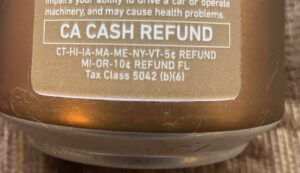
It has been a long time coming, but finally, with our partners, we are going all out for a bottle bill in 2026. Many of you may know that Zero Waste Washington was founded in 1982 by the activists who were trying to get a bottle bill passed in Washington State by voter initiative. The beverage industry spent millions to defeat it, and so the activists pivoted and formed our organization with the goal of working to get bills passed in the Washington legislature.
How things have changed! Now the beverage industry is generally in favor (or at least neutral) and the beverage packaging players (think metal, glass and plastic manufacturers) are very much in favor of a bottle bill. This is because they recognize that they need clean feedstocks of recycled content to make new beverage containers.
Another major benefit of a bottle bill is litter prevention. In states with bottle bills, beverage container litter has been documented to be reduced by around 80%.
How it would work: Under a recycling refund program, Washingtonians would pay a 10-cent deposit when they purchase a drink in plastic, aluminum, or glass containers. They would then receive a 10-cent refund when they return the container to be recycled or reused. Drop-off sites would be located throughout the state, including places offering immediate refunds, as well as stores in local communities that chose to participate in the program. Drop-off locations in retail parking lots would be funded by beverage companies, not Washington residents.
The Bottle Bill (HB 1607/SB 5502) is championed by Representative Monica Stonier and Senator June Robinson. Bottle bill iterations have been part of bills or stand-alone bills for 3 years, and now, in 2026, the effort has significantly ramped up. Stay tuned….
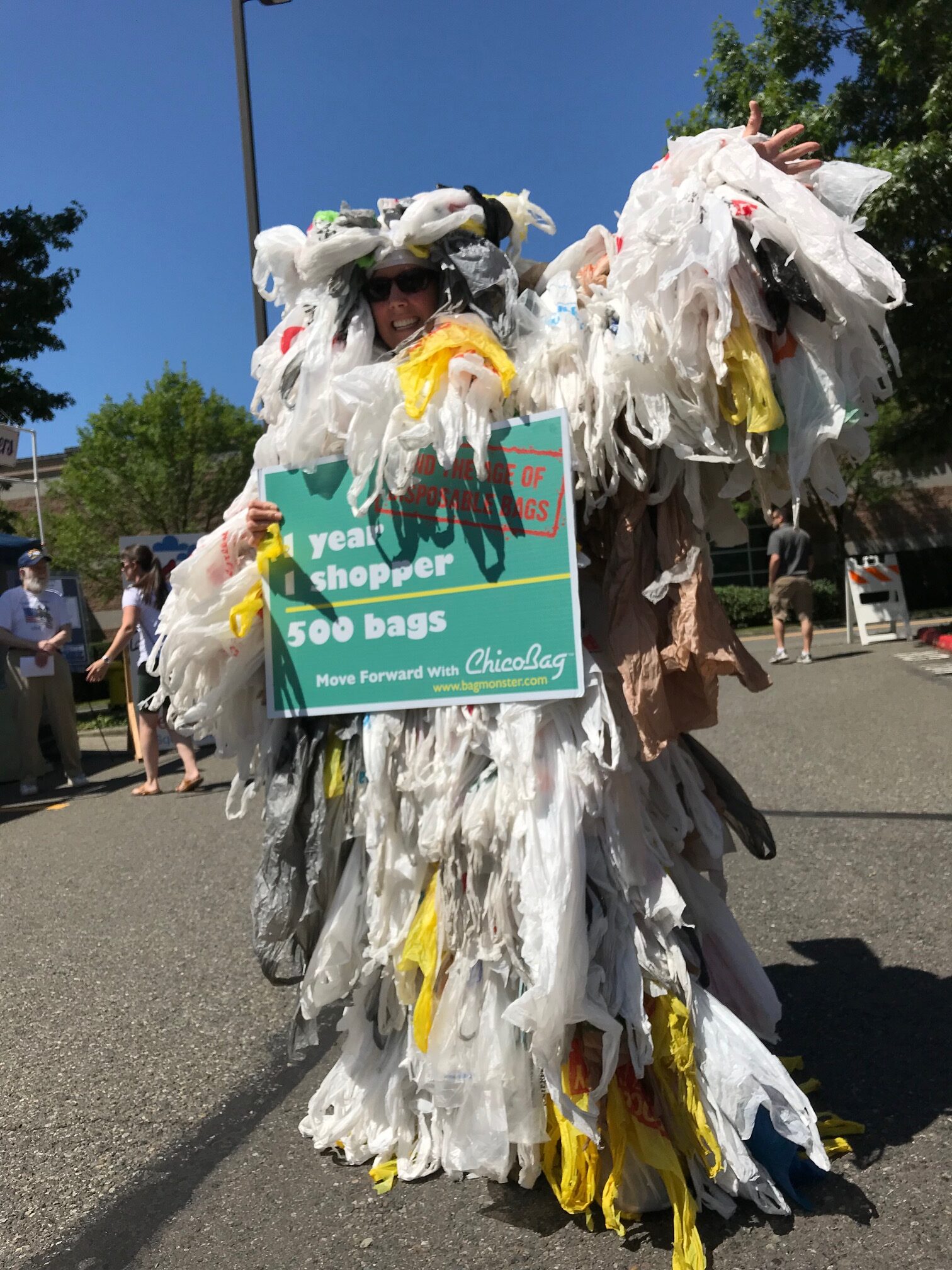
Bag monster in action!
Amending the bag law – time for a ban
It was a big victory when the statewide plastic bag law passed in 2020. But it was not perfect, and it is time for an upgrade. Championed by an all-Olympia team – Representative Lisa Parshley and Senator Jessica Bateman – the bag bill would ban all plastic film bags at checkout. It would increase the fee for large paper bags at checkout to 20 cents. The idea is to motivate people to bring their own bag!
The bill would also clarify that third party delivery services must comply with the law: not using plastic film bags and charging the fee and passing that fee along to the restaurants. Finally, the bill would include a requirement for distributors that they cannot sell banned bags in Washington. We have seen that many restaurants have been able to get the non-compliant bags easily from distributors.
Other bills
Here is a list of the other bills we are working on with our partners that we expect to be advanced in 2026. Note that bill numbers are not included, because some of the continuing bills may have different numbers than last year:
- Mattress Recycling bill. Victoria Hunt and Rep Zach Hall (both from Issaquah!) are leading the effort to increase mattress recycling and reduce illegal dumping. This bill would establish an extended producer responsibility program for mattresses.
- Textile and Apparel recycling bill. Championed by Rep. Kristine Reeves and Sen. Liz Lovelett, this bill would set up an extended producer responsibility program for apparel and textiles and restrict toxic PFAS chemicals in textile products.
- EV Battery recycling bill. Led by Rep. Chipalo Street and Sen Derek Stanford and, this bill would set up a system for ensuring safe recycling or repurposing of EV batteries.
- Household Hazardous Waste bill. The dynamic duo – Rep. Liz Berry and Sen. Liz Lovelett – are leading this bill which would set up an extended producer responsibility program for household hazardous waste products such as pesticides, toxic cleansers, etc.
- Cannabis Packaging bill. Sharon Shewmake is championing this bill to reduce plastic packaging associated with cannabis products and to also require separation of batteries from vapes.
- Post-Consumer Recycled Content bill. Liz Berry is sponsoring this bill that follows up on her and Sen. Mona Das’ bill from 2021 which mandated recycled content in new packaging and products. This bill would add new categories of products and increase accountability and penalties.
- Environmental Crimes bill. Yasmin Trudeau leads this bill to establish a comprehensive framework for prosecuting environmental crimes in Washington State, creating three-tiered violation levels for water pollution, clean air, and hazardous waste offenses. Many of the water pollution crimes that might be included are related to zero waste topics.
- And more…. (i.e., other bills are still in early development)
Activist list
If you are interested, please join our activist list, if you have not already signed up, so that you can receive regular updates about how to help during session: here
Tracking bills
During legislative session, we will keep our legislative page on our website updated daily. As a note, though, we don’t start populating the page until bills start to get introduced in earnest. Here is the link
Thank you all for your help in moving important zero waste bills forward. If you have any questions, please contact Heather at heather@zerowastewashington.org.
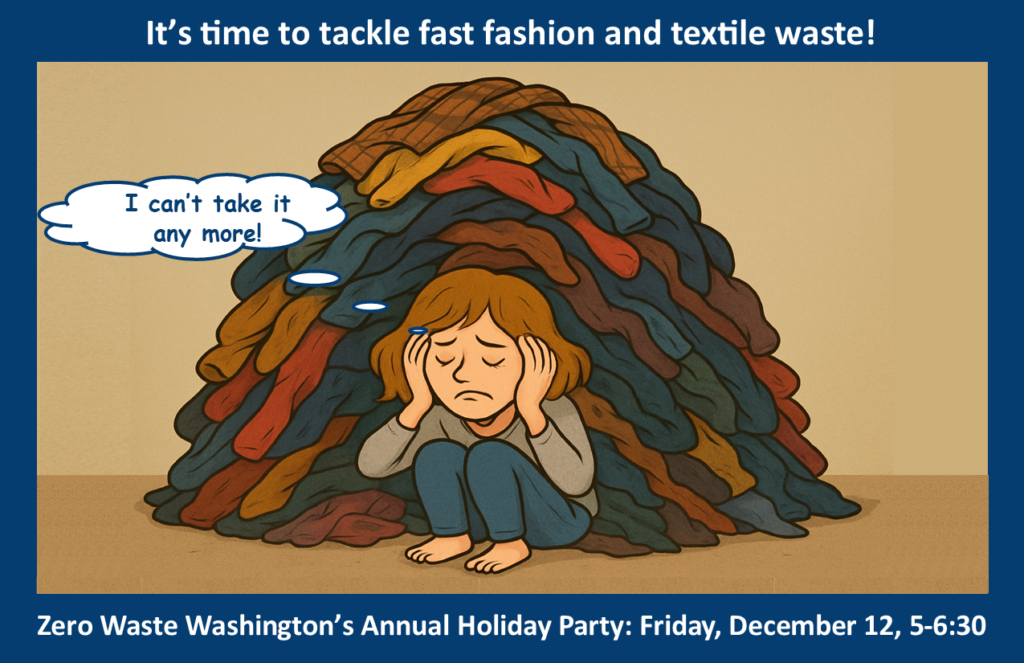 Please join us for
Zero Waste Washington’s
Annual Holiday Party
Friday, December 12, 2025
5—6:30 pm
Via zoom
Please register so we can send you the zoom link: https://zwwparty.bpt.me/
or email: heather@zerowastewsashington.org
Grab a cocktail or other beverage and join us for
great community, quick updates, and fun
trash-themed interactive game show!
 By Nayeli Campos, Community Outreach and Policy Coordinator
Do you “eyeball” your detergent or toss in an extra pod just to be safe? When you pull a shirt from the dryer, do you check for that “fresh linen” scent to know it’s clean? If so, you aren’t alone, but you might be washing your money down the drain, shortening your clothing’s life, and sending toxic chemicals into our local waterways.
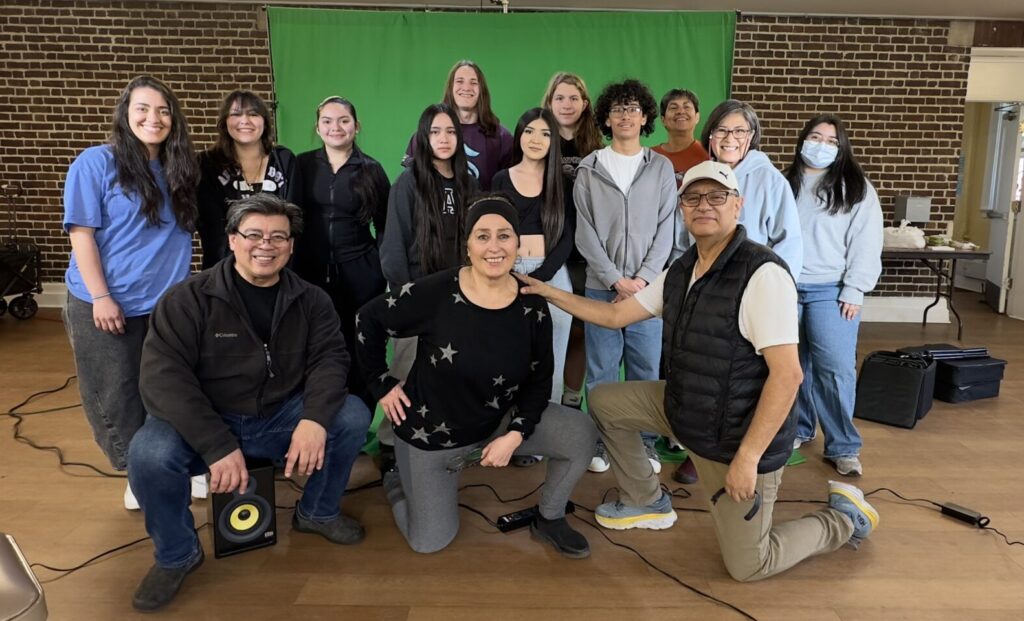
Zero Waste Washington partnered with the Duwamish River Community Coalition to support a cohort of high school students to find out why we wash our clothes the way we do. Our goals? To motivate habits that extend the life of our clothes and reduce the toxic chemical load entering our wastewater system.
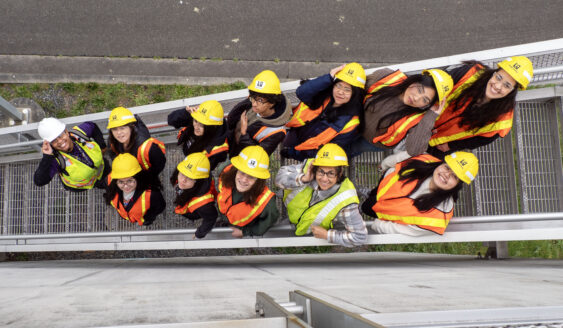
The youth participated in educational sessions and toured local infrastructure, including the Georgetown Wet Weather Treatment Station and the Brightwater Treatment Plant (see banner photo above). They conducted at-home laundry assessments and in-depth behavioral interviews with family, friends, and neighbors. Finally, they tested messaging strategies with over 100 community members to find out what messages inspire sustainable laundry habits.
Youth findings
The students discovered that our community’s laundry habits are driven by a mix of convenience, habit, and marketing. But one of the biggest drivers is scent. They found that 84% of participants judge if their clothes are clean solely by smell.
They also found that over 75% of survey respondents reported using warm or hot water, with many believing it was necessary to clean better. And that high-volume detergent use is widespread. Many residents simply estimate the amount they pour or follow the “fill lines” on detergent caps, which often recommend far more soap than is actually needed. Only 1-2 tablespoons of detergent is usually needed to clean clothes.

 Finding messages that stick
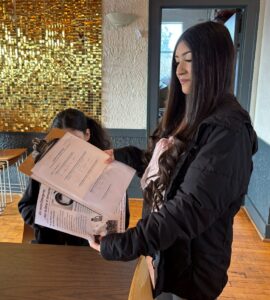
Our youth participants used the data they gathered from their behavioral interviews to create and test five different messaging themes through bilingual factsheets to see what would inspire their community to adopt more sustainable habits. Below are their five key messages:
- Make clothes last longer by washing less
- Use eco-friendly detergent to protect wildlife

- Using less laundry detergent can save you money
- Use less laundry detergent and stop hurting the environment
While the response was positive across the board, the two messages that focused on saving money and protecting the environment were the clear winners, with 75% of respondents reporting they felt inclined to change their habits after reading the fact sheet.
Bringing the Message to Life
To share these findings with the wider community, we partnered with Latino Northwest Communications who supported the youth with professional multimedia training. The youth wrote scripts, filmed, and produced their own educational videos, including a music video and a Public Service Announcement (PSA).
To learn more about the project, the data, and the methodology, check out our full Situational Analysis of Residential Laundry Practices report here.
For more information or questions about this project contact Nayeli at nayeli@zerowastewashington.org
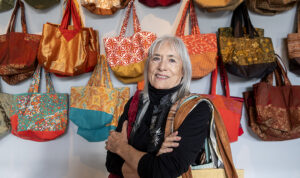 Meet Karen Guzak. She is a long-time activist and politician in the City of Snohomish. Furthermore, she is an award-winning artist. And now she is known as the “bagwoman of Snohomish” and her bags are gorgeous.
From Boulder to Snohomish
Karen grew up in Boulder, Colorado, attended The University of Colorado, moved to Seattle, landing at Cornish for a BFA, and then taught and worked as a visual artist in Seattle. The handrail design at the King County Council, that is Karen! The large circular compass design for the Overlake Transit Center located at Microsoft campus in Redmond, WA. Karen too! Her paintings and prints are in numerous museums ranging from the Brooklyn Museum and the Pratt Institute on the east coast to Gonzaga University and the Portland Art Museum on the west coast. Some of her prints have been translated to wool rugs woven in Kathmandu, Nepal.
After she moved to Snohomish, she continued work as an artist and also founded the Yoga Circle Studio.
Karen accumulated 16 years of elected service on the Snohomish City Council, including seven years as Mayor. And while she was mayor, Karen was the major force behind the bag ban ordinance in the City of Snohomish!
How bag making started
The Snohomish bag ordinance passed just before the COVID pandemic started. During the pandemic, Karen started deep cleaning her closets which were full of fabrics she had collected over the years, and that inspired her to start making bags. As her effort grew, people kept giving her more and more fabric for making bags.
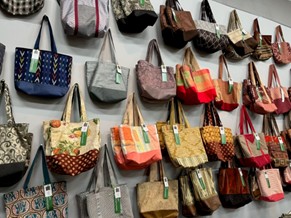
Now, she has three friends who are hard core thrifters, who go as far afield as Whidbey Island to find interesting items. They bring her all sorts of material. She especially likes to work with upholstery fabric because of its heavier weight, and tablecloths and curtains work as well. She looks for those with interesting textures or images and contrasts.
On occasion, just like with memory quilts, Karen will create a custom bag for someone made from a special clothing item. Recently, she did one from old pants.
 “I already have too many bags!”
Karen hears this all the time. Her response is “Get rid of your old bags and give those to the food banks. They need a lot of bags. And then, get a beautiful bag that you will use all the time. We are notching you up!”
She sees people getting one of her bags and using it as their everything bag, tucking their purse or wallet inside, so that it is always with people for all of their needs. Others use them for knitting bags or their book bags, or as bags to hold gifts.
Strong and gorgeous
Her bestselling bags have rich colors. The bags are about the capacity of a grocery paper bag and can carry 40-50 pounds. She makes the handle thick so that they are strong.
As a visual artist, she has that sense of flair. Often the bags have a slightly quirky edge. According to Karen “Beauty is the primary requirement.”
How to get one
Karen sells her bags online (see below), but she mainly sells them at her studio home (AngelArmWorks), which is a converted 155-year-old historic church in downtown Snohomish.
Karen and her partner, Warner Blake, make a big positive impact on the community. They host numerous events throughout the year, such as parties and fundraisers for a cause, at their studio/home. Many people see the bags at these events and buy them on the spot.
Snohomish Parlour Tour this Sunday
If you are looking for a fun activity this weekend, you might want to come do the Snohomish Parlour Tour, on Sunday, December 14, 12-4 pm, hosted by the Snohomish Historical Society. Link: https://snohomishhistoricalsociety.org/parlour-tour
The tour features a mix of 15 historic landmarks, including charming churches, beautifully decorated historic homes and the Blackman Museum—all dressed in festive holiday splendor. It also includes a holiday market at St. Michael’s Church
Karen and Warner’s home is one of the stops!
Find out more about Karen’s bags and the opportunity to purchase them at https://www.angelarmsworks.net/
 By Andrea Ramirez, Sustainability Analyst
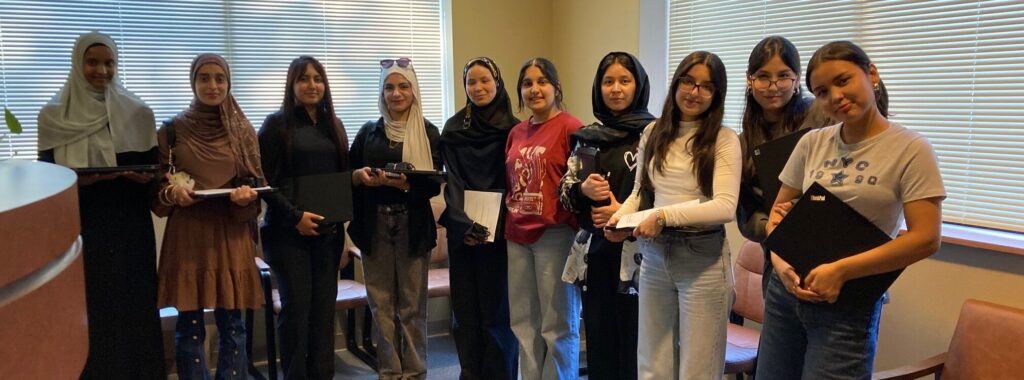
In collaborative with our partner New Americans Alliance for Policy and Research (NAAPR), we are working on a youth project focused on their policy leadership development while raising awareness within the community about exposure to toxic chemicals.
NAAPR is not only committed to amplifying the voices of refugees and immigrants but also truly believes in their ability to mobilize others in a positive way. Within this project, NAAPR staff recruited youth who were interested in learning and addressing environmental issues within their communities (Somalia, Afghanistan, Iraq and Syria recent immigrants). The new Youth Policy Council will take the lead in advocating and proposing initiatives that overcome barriers and promote a healthy and safe environment for all.
Empowering youth through education
Since July, the youth have participated in interactive learning sessions designed to deepen their understanding of environmental issues, emphasizing exposure to toxins and the related health impacts people could be facing. These sessions have also incorporated the importance of regulatory gaps and ongoing advocacy efforts aimed at addressing community needs.
Some quotes from youth during educational sessions:
- “All this was new information to me, I never thought these products could be harmful” – Hasina
- “I wasn’t aware of the presence of lead in makeup, especially in Surma. I don’t use it, but my mom does” – Mahtab
- “I think now I will maybe get a mineral sunscreen and research the ingredients before.” -Shahed
- “Even though it was my presentation, I still found all the information surprising. I was learning a lot while making it.” – Rawan
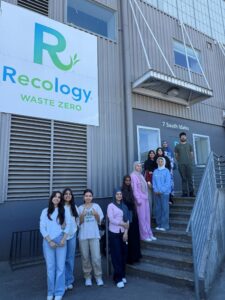 Where does it go? Learning about recycling
As part of the project curriculum, the youth had the opportunity to visit Recology recycling facility in South Park to experience the entire process on site. They received a presentation about recycling, composting, landfilling and how materials are sorted at the facility. The tour also included a walk-through of the machinery so they could experience from the beginning how paper, plastic, aluminum and glass are separated into the different streams. The youth were impressed with the manual labor required, high speed scanners and also with the integration of robots functioning with AI technology to facilitate the recycling process.
Most of the youth did not grow up with recycling infrastructures in their home countries. As a result, the tour offered them valuable learning opportunities.
After the tour, we had a picnic lunch at a park along the Duwamish River. The youth loved seeing (and hearing from) workers sailing along on barges headed to Alaska
Surveying the community
To wrap up the year, the youth are conducting community surveys designed by them, aiming to collect data about current exposure to toxic chemicals in homes and neighborhoods, education gaps, community environmental concerns, existing barriers, and potential actions that could address these issues. Responses from the surveys will help the youth to identify areas of opportunity to support the focus communities while promoting equity and long-term policy changes.
Contact Andrea at andrea@zerowastewashington.org with questions about the project
Our end-of-year campaign has launched! Please join Zero Waste Washington and support us with your tax deductible gift.
Did someone forward this newsletter to you? Please sign yourself up here
Check out our 2025 Year in Review here
And could you support us with your tax-deductible gift? Your gift enables us to continue making Washington State’s waterways, communities, and the air we breathe healthy and waste free.
Please join this effort and donate today!
Zero Waste Washington cannot do this work without you. Thanks for joining us!
Donate here
Zero Waste Washington
PO Box 84817 * Seattle, WA * 98124
(206) 441-1790
