

Zero Waste Washington drives policy change for a healthy and waste-free world. We envision a just, equitable, and sustainable future where we all produce, consume, and reuse responsibly.
Dear Zero Waste Washington Community,
After ten wonderful years, I am writing to share that I will be stepping down from my role as Executive Director of Zero Waste Washington. Effective January 1, 2027, I will transition into the role of Policy Director.
Passing the baton to the next generation of leadership is a change I have considered for several years. While I had originally targeted 2027 for this transition, the sudden passing of my husband this summer accelerated my decision. It helped to put things into perspective for me.
I am delighted to announce that our Board of Directors has approved Moji Igun as our interim Executive Director, effective January 1. Moji is an exceptional leader, a skilled facilitator, and deeply embedded in the zero-waste community. For example, she already represents Zero Waste Washington on the WA Recycling Reform Act Advisory Committee.
When I joined Zero Waste Washington, I was inspired by its history of meaningful impact, its vast network of partners, and its vision for a sustainable, healthy, and equitable waste-free future. Over the past decade, our organization has grown even stronger thanks to the dedicated work of our staff, board, volunteers, partners, donors, and advocates. It is an honor be part of this work.
I look forward to supporting our mission in my new capacity as Policy Director. Zero Waste Washington is rooted in strong values, guided by a committed board and talented team, and backed by an amazing and vast community. I have full confidence that the organization will continue to adapt, lead, and inspire in the years ahead.
Thank you for all the ways you have supported me and our team.
Warmly,
Heather
Thank you all for your help over the years in building the zero waste movement. If you have any questions, please contact Heather at heather@zerowastewashington.org.
There is no better way to learn about zero waste issues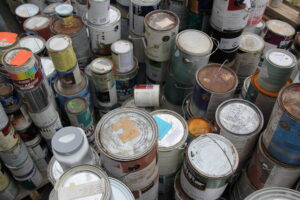 than joining a tour! We are happy to announce a suite of tours covering critical issues that Zero Waste Washington and others have been working on in the policy arena.
Space is limited. Lunch will be provided.
- Mattress Recycling – Arlington Recycling – Mukilteo. Friday, October 16. 12-2 pm. Over 90% of a mattress is recyclable! And it is fascinating to see the innards of a mattress and how the various components get managed on their recycling journey.
- Composting – Cedar Grove – Everett. Monday, November 9. 10 am -12 pm. See how food and yard waste get turned into healthy compost in short order at an industrial compost facility. You will especially like seeing the techniques used to remove plastic and other contamination from the compost.
- Paint recycling – GreenSheen – Sumner. Wednesday, December 2. 12-3 pm. Latex paint can be easily recycled, and the “new” paint is carefully matched to a variety of popular colors. These paints are sold at half the price at places like Habitat for Humanity and other locations.
To sign up, please click here
We will establish a waiting list if tours are oversubscribed.
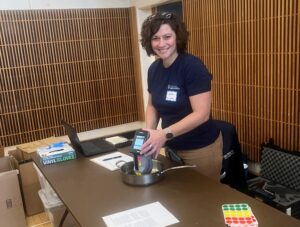
Katie Fellows, King County Hazardous Waste Management Program, testing pans for lead contamination
By Nayeli Campos, Community Outreach and Policy Coordinator
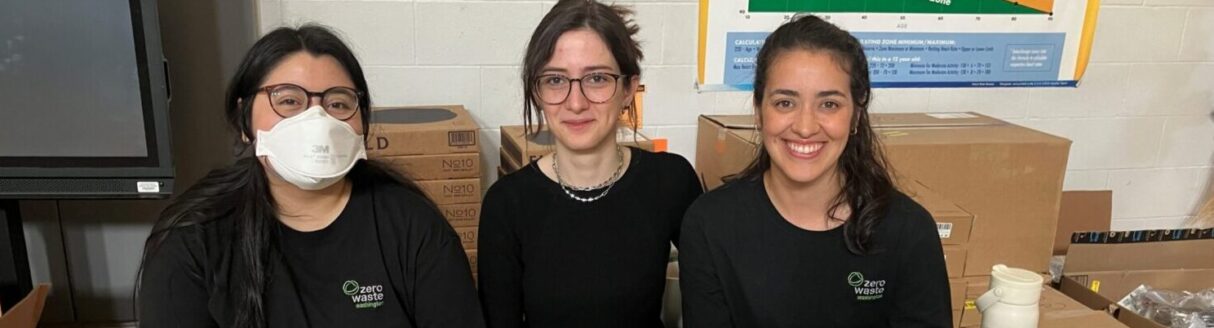
Note: the banner photo above shows Zero Waste Washington’s Nayeli Campos, Bengu Smith, and Andrea Ramirez at the Sept 12 swap-out event, with the pans on offer!
Zero Waste Washington, along with many partners, is conducting a multi-year project to encourage the public to replace household products that contain toxic chemicals with safer alternatives. We are prioritizing pots and pans with non-stick coatings which contain PFAs and are also often contaminated with lead, plastic cutting boards and kitchen utensils which shed nano- and micro-plastics into food, and more. This fall, we have kicked off a series of community-centered swap-out events.
Funded by USEPA through the Washington State Department of Ecology, this pass-through grant program provides up to $50,000 to municipal partners across Snohomish, Kitsap, Pierce, and King counties for swap-out events. Families bring in cookware and kitchen items for lead testing and leave with free, high-quality safe products.
September 12 event for fishing communities in the Duwamish Valley
On September 12 we supported a swap-out event led by Public Health – Seattle & King County’s “Fun to Catch, Toxic to Eat” program and the King County Hazardous Waste Management Program. Public Health leads this program on behalf of the EPA as a critical human-health protection strategy for the Lower Duwamish River Superfund site. The program works to protect priority residential fishing communities, especially pregnant women, nursing mothers, and young children via an incredible network of more than 40 Community Health Advocates representing Vietnamese, Latinx, Khmer, and Laotian fishing communities.
 A Day of Interactive Testing and Exchange
During the swap-out event, Community Health Advocates welcomed families and friends, helped manage flow, and provided real-time interpretation.
Each participating family had their cookware items logged and screened by King County Hazardous Waste scientists using specialized X-Ray Fluorescence (XRF) analyzers to detect lead contamination. Staff also performed visual inspections of non-stick coatings, screening for scratches and peeling that could potentially indicate active chemical leaching.
Participants were guided through their test results, helping families understand why specific items posed health risks and recommending that contaminated items or damaged non-stick pans be left for proper disposal.
While testing was underway, families visited different tables to choose brand-new, safe alternatives. Each family received a fry pan, cutting board, wood or stainless steel cooking utensils, and a stainless steel colander. Families with babies also received non-toxic organic cotton play mats and stainless steel children’s sipper bottles, while local fishers received lead-free tackle, including sinkers, weights, and weighted lines.
A total of 110 households attended and received safe household items. 276 kitchen items were individually screened on-site for heavy metals. Many toxic lead, degraded non-stick, and microplastic-shedding kitchen items were permanently removed from circulation.
 September 26 event for residents in Kent
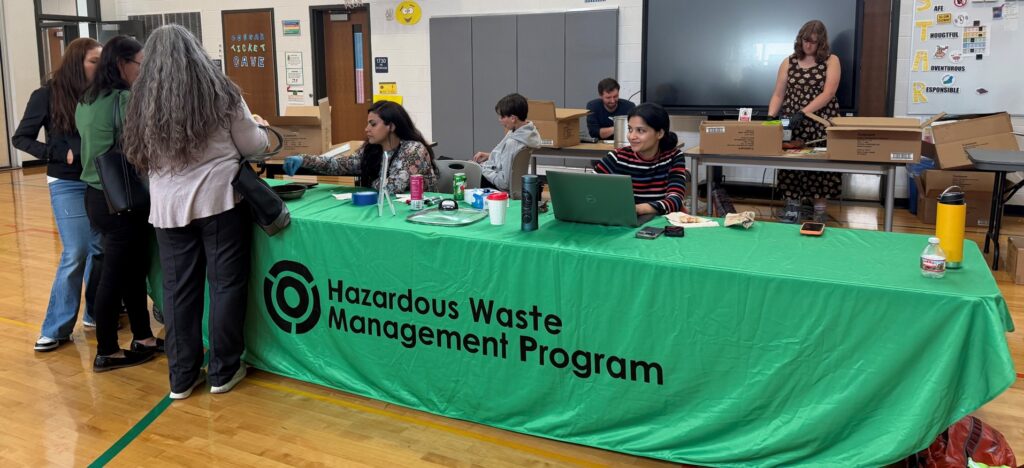
Just last Saturday, we supported a community swap-out event that was hosted by King County Hazardous Materials and the City of Kent. Approximately 100 families received fry pans, sauce pans, kitchen utensils and cutting boards. Participants could bring in up to 3 pots and pans for testing.
Bring a Swap-Out Event to Your Community: Apply for Funding!
This successful kick-off is just the beginning! Zero Waste Washington is actively collaborating with regional partners on upcoming fall, winter, and 2027 swap-out events!
Zero Waste Washington is accepting proposals on a rolling basis from public jurisdictions in Snohomish, Kitsap, Pierce, and King counties. Whether your team is interested in hosting a single community swap-out event or rolling out a series of neighborhood educational workshops, we want to help make it happen!
A huge thank you to our funders at the EPA and the Washington State Department of Ecology, our phenomenal community partners at PHSKC and King County Hazardous Waste and the City of Kent, and every family who joined us to build a cleaner, safer community!
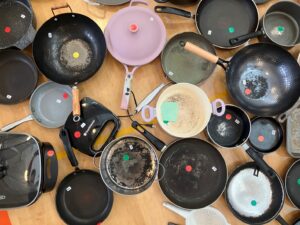
Some of the cookware collected at Sept 12 swap-out event
Why Swapping These Items Matters
PFAS in Non-Stick Coatings – Most conventional non-stick pots and pans (including rice cookers, grills and waffle irons) use per- and polyfluoroalkyl substances (PFA) as the non-stick surface. PFAs are known as “forever chemicals” because they do not break down easily in the environment. This class of thousands of synthetic chemicals bioaccumulates in humans and the environment, with exposure linked to increased cholesterol, compromised immune function, endocrine disruption, kidney and testicular cancers, and harmful reproductive effects. When non-stick surfaces overheat, age, or scratch, these compounds shed directly into the food being prepared. Unfortunately, most of the pans we collected at the swap out events show scratches and patches of worn-out areas.
Lead in Cookware – Many aluminum or brass cookware items have lead contamination. Because there is no safe blood lead level, and lead is particularly harmful for infants, children, and pregnant individuals, ingesting even trace amounts can lead to permanent neurological damage, developmental delays, and behavioral challenges. Over the past three legislative sessions, Zero Waste Washington and partners worked to reduce (or eliminate) lead in cookware sold in Washington (see legislative page for the most recent bill).
Microplastics in Cookware – Everyday plastic cutting boards and kitchen utensils are been shown to shed millions of microscopic plastic fibers directly into food we prepare in our kitchens. In addition to physical microplastic particles, plastics can transport a cocktail of chemical additives, including endocrine-disrupting phthalates and flame retardants, straight to the dinner table.
Lead in Recreational Fishing Gear – Traditional leaded fishing gear poses severe heavy-metal ingestion risks to wildlife as well as direct exposure hazards to fishers and families when handled. Non-lead alternatives are readily available in the marketplace.
If you know of a jurisdiction that might be interested in hosting a community swap event, or have questions about this project please contact Nayeli at nayeli@zerowastewashington.org
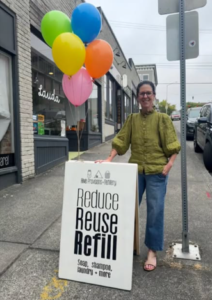 By Andrea Ramirez, Sustainability Analyst
Refillery shops offer an easy alternative to single-use packaged items for everyday household essentials, personal care products, bulk food items and more. They’re also a wonderful way to support local makers and farmers while discovering products made with clean, non-toxic ingredients that can become part of a more mindful daily routine.
We interviewed two wonderful store owners who opened refillery stores in 2026 in Tacoma and Spokane. These stores join a growing cadre of outlets across Washington.
Hive Provisions + Refillery
Michele Jones reopened Hive Provisions + Refillery in Tacoma just a few months ago, bringing back a carefully curated selection of everyday goods and gifts from small and local makers.
This time, she has also introduced a refillery section, offering a range of household and personal care products designed to be clean, practical, and refillable. Adding a refillery had always been an idea Michele wanted to pursue, and after noticing a gap in the area, she saw an opportunity to bring more sustainable, refillable options to the community. You can find a great variety of things such as powder and liquid laundry detergents, dishwasher, stain removers, dryer sheet liquid, dish soaps, cleaners, hand soaps, body wash, shampoo, conditioner, hair care, deodorant, face wash, moisturizers, lotions, toothpaste tablets, floss, and one food product, which is a coffee dust sourced from Vashon Island.
What if I forgot my empty container for refilling?
No need to worry. Currently there is a “library jar” at the store that could provide free and clean containers to carry the products in, or there are other options for purchase at the store, including durable hand pumps for you to keep refilling when needed. You are also welcome to drop off extra containers you might have at home – just ask Michele about what is acceptable and bring them over!
“I try to keep as much as I can to reuse because I also ship to other states, so I’m always looking for packaging and boxes. I also have a goal to expand more to where I could receive special materials from people and then partner with other organizations to essentially be like a drop-off point” – Michele Jones
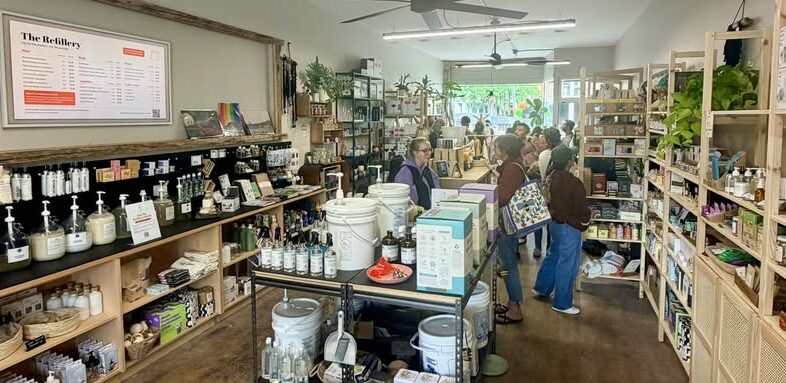
Michele is always looking for ways to keep prices accessible, understand what her customers are looking for, and incorporate their feedback and suggestions into the shop. Stay tuned for new products to be added to the refillery, adding a members’ subscription with special perks and rewards, and more.
“The community response has been really encouraging. I love it when people just walk in with their jars…it is really inspiring” – Michele Jones
Michele is also supporting local small businesses
Michele has also been working with a few small businesses to refill essential products they use for their operations. She is hoping to expand this service to others interested in the city and be able to bring convenient, clean, and low-cost options while reducing her shipping and packaging footprint.
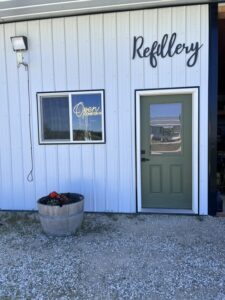 Renewed and Recycled Refillery
Located in Deer Park, just north of Spokane, Carrie Sampson opened her refillery store, Renewed and Recycled Refillery, in March 2026. She was inspired to open her store after becoming a mom and learning about the risks of exposures to toxic chemicals in daily products. Carrie felt so overwhelmed when researching and choosing the right products, that she started to make her own laundry detergent and other goods for her household and personal use.
She wished, however, there was just one place in the area that offered all the essentials made with clean ingredients… that would make her life – and others – so much easier. Thus, Carrie decided to open a convenient shop on her farm.
“We work with as many local businesses as possible, so we have a lot of local makers in our shop, and then we carry products from other regional brands with closed loop systems” – Carrie Sampson
Renewed and Recycled Refillery offers a variety of refillable cleaning and personal care products, such as laundry detergent, dish soap, hand soap, shampoo, conditioners, lotions, body wash, makeup remover, bath soaps. You also can find a selection of shelf-stable food items to refill, including local honey, organic granola, chocolate chips, olive oil, balsamic, apple cider vinegar, maple syrup, coffee, tea, and more.
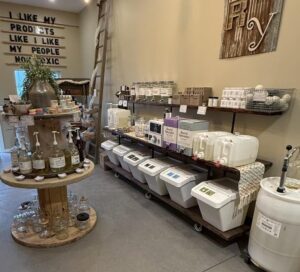 n addition, Carrie also has an inventory with other non-toxic specialized items such as tallow-based products, cosmetics (concealers, blush, mascara, etc.), baby products (chest vapor rub, ear ointment, etc.), pet products, and a line of immune boost supplements for various health needs (parasites, heartburn, headache, etc.)
“I sample everything that’s in the shop. I use it in my own home on my own family, so everything that is in the store, I can say that I’ve used it first” – Carrie Sampson
After months of operation, customer retention has been great, and word of mouth has helped the business tremendously. Customers try the products, love them, and continue coming back, even those who travel from more remote areas. According to Carrie, shoppers typically purchase a reusable container during their first visit and bring it back each time they return for a refill. More recently, the shop introduced a community jar bin for customers who have extra clean, empty glass jars with lids to share, and those are free!
See refilleries and stores with bulk sections across Washington on our website: here
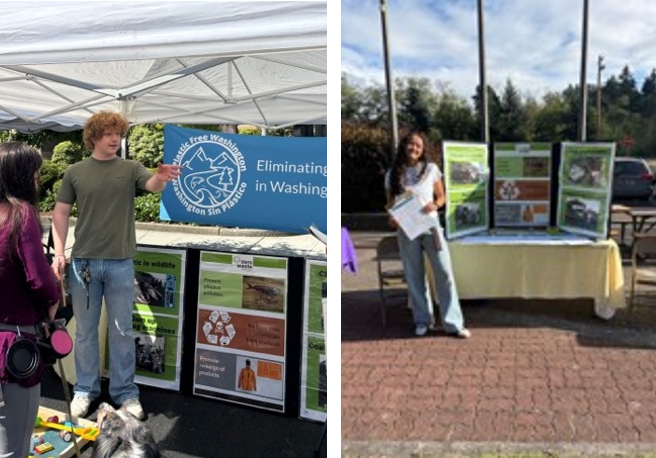 We are two University of Washington interns, Aiden Campbell and McKenna Mitchell, working with Zero Waste Washington under the guidance of executive director, Heather Trim. While McKenna is from Tacoma, Washington, and Aiden comes all the way from Wilmette, Illinois, we both share a passion for environmental policy and creating a sustainable future.
We are both undergraduate students in UW’s Program on the Environment and Political Science. To complete our degree in Environmental Studies, we are currently conducting Senior Capstone Projects, a three-quarter long experience that allows us to combine academic research with hands-on work in the environmental field. In the second quarter of the Capstone series, we gained professional experience through our internship with Zero Waste Washington, while conducting research on public perceptions, behaviors, and barriers to supporting plastic reduction policies. Our research considers perspectives from both the public and elected officials across Washington State.
Our outreach project
As Plastics Campaign interns, which we did for the Plastic Free Washington Coalition, we contributed to several projects supporting efforts to amend Washington’s plastic bag law. One of our main tasks was creating educational factsheets, with support from Sea & Shore Solutions LLC, to help inform the public and local legislators about the impacts of plastic pollution on human health and wildlife. We also highlighted how strengthening Washington’s plastic bag law could reduce these impacts.
Beyond these projects and our research, we have also enjoyed engaging with the community by hosting booths at outreach events. These events allow us to promote our factsheets, answer questions, and hear the perspectives of the community. Additionally, they offered a space for us to incorporate our Capstone research, such as through the distribution of surveys or observing engagement with plastic reduction strategies.
What’s next for us
Looking ahead, we both envision a future that builds upon our care for the natural world and our interest in policy. After graduating from UW, Aiden hopes to pursue a joint J.D./M.P.A (Masters in Public Administration) within the next 2-3 years, while McKenna plans to pursue an M.A. in Global Environmental Politics.
We are both incredibly grateful for this opportunity to work under Dr. Trim and the Zero Waste Washington team. This internship has given us valuable insight into environmental policy, and the chance to contribute to a meaningful movement to reduce waste and pollution in the place we call home, or in Aiden’s case, second home!
Big thank you to the NW Fund for the Environment for funding to support the plastics educational campaign.
We are excited to announce the launch of the Washington Reuse online platform, in partnership with Repair+Reuse Washington, the Good Business Network of Washington, the WA Recycling Development Center and numerous organizations and agencies across Washington.
The free business to business materials exchange platform launches October 17. It is like Craig’s list or Facebook marketplace, but it’s for businesses and is Washington focused.
WA Reuses, is designed to help businesses and organizations sell, donate, and find valuable materials that would otherwise go to landfill. We are talking about construction and deconstruction materials, pallets, commercial equipment and surplus supplies, cardboard tubes, and more.
We especially hope that businesses will take advantage of the platform to get rid of materials that are difficult to recycle or dispose, thus saving disposal costs and helping divert the materials from the landfill. The platform will allow for the creation of reports to document waste diversions quantities.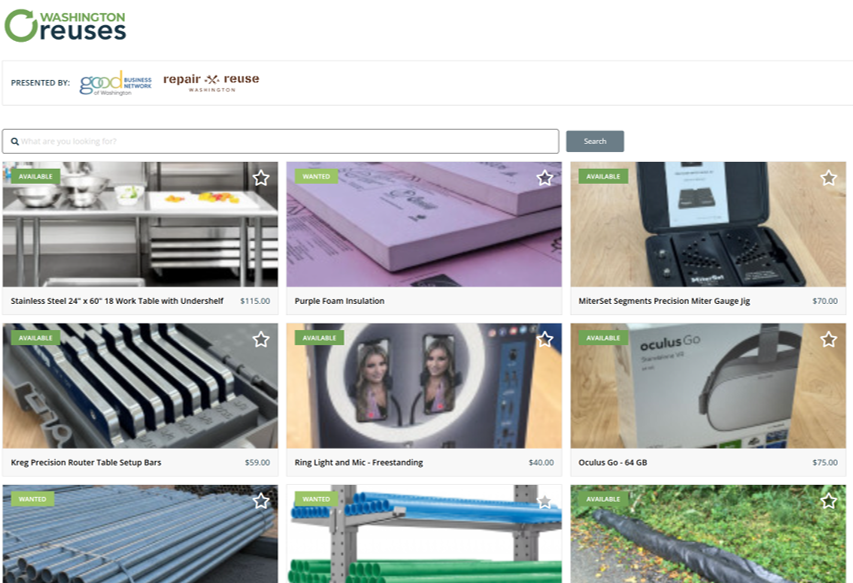
The new marketplace is easy to use, with just a few clicks. There is no fee to list items and all transactions or donations are handled offline.
- To get started making listings or to post “wants,” sign up for a free account at wa.reuses.com and make your first posts.
- Have questions, or aren’t ready to post? Join the WA Reuses Community Forum to receive updates about the platform, events, listing roundups, and more.
This project was started by Kami Bruner, former Zero Waste Washington employee and now director of Repair+Reuse Washington (a fiscal sponsoree of Zero Waste Washington) in 2025, with a grant from the Recycling Development Center. The online platform is managed by iwastenot.org.
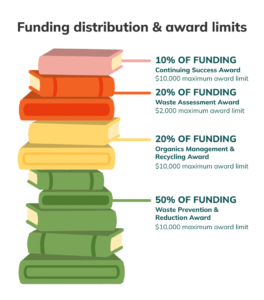 If you know of a K-12 school in Washington that is working towards waste reduction, reuse, recycling, and composting, please let them know about this grant opportunity (and maybe you can help them out!). Offered through the State Department of Ecology, the annual Waste Not Washington School Awards (which is actually a grant program) cover programs and lessons. This year’s deadline is October 31.
Zero Waste Washington and partners worked to get these grants increased from $5000 to $10000 per school, as part of the new organics management laws.
The total amount of funding available for the 2026-2027 cycle is $260,000. No matching funds are required. Individual schools are eligible for one award per award cycle. School districts with 29 or fewer schools may receive one award per cycle. School districts with 30 or more schools may receive up to two awards per cycle
For more information: https://ecology.wa.gov/about-us/who-we-are/our-programs/solid-waste-management/waste-not-washington-school-awards
Our end-of-year campaign has launched! Please join Zero Waste Washington and support us with your tax deductible gift.
Did someone forward this newsletter to you? Please sign yourself up here
Check out our 2025 Year in Review here
And could you support us with your tax-deductible gift? Your gift enables us to continue making Washington State’s waterways, communities, and the air we breathe healthy and waste free.
Please join this effort and donate today!
Zero Waste Washington cannot do this work without you. Thanks for joining us!
Donate here
Zero Waste Washington
PO Box 84817 * Seattle, WA * 98124
(206) 441-1790
