

Zero Waste Washington drives policy change for a healthy and waste-free world. We envision a just, equitable, and sustainable future where we all produce, consume, and reuse responsibly.
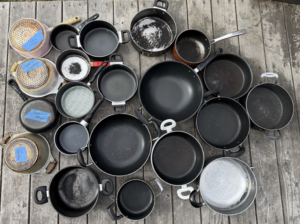
Used nonstick pans collected at swap events. Some of these tested positive for lead contamination.
Do you have any older nonstick pans in your kitchen? It is time to replace them! They are likely coated with toxic PFAS (Per- and polyfluoroalkyl substances) which can migrate into your food during cooking, especially fatty foods. Furthermore, those pans, if they are aluminum, have a pretty good chance of having lead contamination. Both PFAS and lead are known to have numerous human health impacts. And don’t forget about small appliances like waffle makers, rice cookers, pressure cookers and other items with non-stick surfaces. You might want to replace those as well.
Importantly, please do not give them away to friends and family or donate to thrift stores. These items need to get out of circulation. Some cities and counties will accept pots and pans for metal recycling.
Zero Waste Washington and partners were already working on trying to get PFAS and lead-contaminated household products out of your homes (see “Applications available” article below). And this legislative session only brought this home. We spent many, many hours working on “defense” on an industry-led bill (SB 5975) to roll back the protections enacted in 2025 Lead in Cookware Law. The very fact that industry was so aggressive on rolling back the protections indicates that they are indeed worried about lead in their products.
2026 was a challenging year
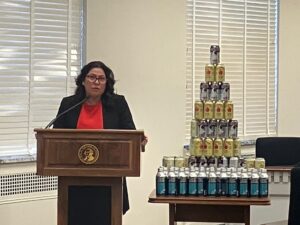
Rep. Monica Stonier at the Bottle Bill press event.
As many of you know, the 2026 legislative session, which concluded March 12, was one of the toughest in recent history. Due to the significant state budget deficit (compounded by huge federal cuts), legislators were faced with difficult choices of which programs to scale back or eliminate altogether. So, there was just no runway for new programs or even modest modifications of existing programs. The good news is the passage of the Millionaire Income Tax, which will bring some relief in the future.
In the positive column, there was a large suite of zero waste-related bills that advanced – most had at least one hearing – and so are well positioned to come back stronger in 2027. These are briefly summarized below.
Zero waste-related bills that passed in 2026
Six bills were passed and have been signed by the governor. These are, in brief:
- SB 6087 – Donating used baby items. Led by Sen Braun, this new law expands the definition of donated children’s items to include strollers and car seats (re protection from liability). This will make it much easier for car seats and strollers to have a longer life. Did you know that car seats have a sticker that shows their expiration date and it is usually 7-10 years!
- HB 1302 – Utility waiver related to industrial symbiosis. Led by Rep Cortes, this law will allow municipal utilities to waive connection charges for properties used for industrial symbiosis, in which the waste of one business is used beneficially by another. Zero Waste Washington has been a big proponent of industrial symbiosis.
- HB 2238 – Improving food flows. Sponsored by Rep Reeves, this law requires the WA Dept of Agriculture to monitor and coordinate food system performance and to develop a strategy to enhance statewide food security by December 1, 2027. A component of the effort would look at food recovery that is going to food banks, specifically by intersecting with Ecology’s Center for Sustainable Food Management (i.e., to reduce food waste!).
- HB 2199 – Cleaning up derelict boats. Championed by Rep Richards, this law makes it easier to remove derelict vessels by removing the requirement that the owner is known and allowing for the removal of vessels that have been in violation of registration requirements for at least two years. Derelict vessels are unfortunately a large part of our marine debris problem in state waters.
- SB 6092 / HB 2416 – Spokane incinerator relief. Led by Rep. Hill and Sen Riccelli this law delays compliance for the Spokane waste-to-energy facility with climate laws. We (statewide environmental groups) worked with Spokane-based environmental groups and with the City to develop a glide path in which the greenhouse gas emissions from the facility will be reduced over time. The City, with strong input from the public, will create a waste management gameplan for how they will reduce their waste and thus reduce emissions on a timeline.
- SB 5975 / HB 2344 – Lead in cookware. This aforementioned bill, sponsored by Sen Harris and Rep Low, delays the standards for lead contamination in pots and pans and places other cookware into the state’s Safer program for analysis and eventual action. We do not love the final bill, but the rollback is not as dramatic as the industry wanted, which went way too far.

Collage of participants at Plastic-Free Washington lobby day (Jan 19, 2026). Rep. Lisa Parshley (champion of the plastic bag ban bill) is in the center, holding reusable bag. Due to scheduling logistics, we were unable to get everyone in one photo.
Bills with forward action
A wide range of zero waste-related bills had hearings or significant lobbying this year. Super briefly, these are:
Plastics, recycling, litter
- HB 1607/SB 5502 – Bottles and Cans Recycling Refund Act (aka Bottle Bill) – our priority bill. Washingtonians would pay a 10-cent deposit when they purchase a drink in plastic, aluminum, or glass containers.
- SB 5965 / HB 2233 – Amending plastic bag law. Would amend the existing law to ban all film plastic bags at check-out and increase the fee for paper bags.
- HB 2212 – Microfiber filtration. Would require commercial washing machines to include filters that capture microfibers before they enter wastewater.
- SB 6156 / HB 2271 – Post-consumer recycled (PCR) content. Would add additional product categories (rigid plastic items) and packaging categories (film) to the state’s existing PCR law to add value to recycling.
- SB 6303 – Cannabis packaging. Would require the Liquor and Cannabis Board to adopt rules to reduce plastic packaging, plastic tags on individual cannabis plants, and require removable batteries in vapes.
Extended producer responsibility (EPR)
- HB 2301 – Expanding paint recycling program. Would add paint thinner, paint remover, sealants, aerosol coatings and more to be collected and processed under the existing paint program.
- SB 6174 / HB 1420 – Textile producer responsibility. Would set up an extended producer responsibility program for apparel and textiles, modeled after the bill that passed recently in California.
- SB 6271 / HG 2633 – Mattress recycling. Would set up an extended producer responsibility bill for mattresses. Mattresses take up a large amount of room in landfills and are over 85% recyclable.
Toxic chemicals in products
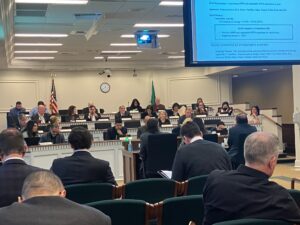
Hearing on the 6PPD in Tires Bill
- HB 2402 – DEHP in IV containers and tubes. Would ban toxic DEHP (a specific phthalate) in intravenous solution containers (by 2028) or intravenous tubing (by 2035).
- SB 6119 / HB 2421 – 6ppd in tires. Would protect salmon and human health by phasing out toxic 6PPD in tires by 2035. 6PPD is in tires to reduce oxidation and, unfortunately, kills returning coho salmon in rivers and streams before they can lay their eggs.
Reuse and repair
- SB 6222 / HB 2432 – Surplus computers to students. Would allow school districts to sell surplus e-devises at depreciated cost to public school students and at no cost to low-income students.
- HB 2175 – Reusable medical equipment. Would exempt non-profit providers of free durable medical equipment from retail sales and use tax for certain items.
- SB 6124 – Reparability of appliances. Would require a Commerce study looking at the development of an affordability index (reparability, ease of maintenance, access to parts) for appliances sold into WA.
Legal
- SB 5360 – Environmental crimes. Would establish new crimes and provide penalties and exceptions, and reclassify existing crimes, for certain violations of the state environmental laws related to pollution.
To find out more details about bills and their final status, please check out our legislative website: here
Big thank you to our activists!
In addition to all of our partners who helped work on bills (thank you!), we also want to thank our activists who signed in PRO (and for the lead bill, CON!) and sent in comments to legislators at key moments. The legislators definitely pay attention! A bouquet of thank yous to you!
If you are interested in being added to our activist list to help next year, please click here
Thank you all for your help in moving important zero waste bills forward. If you have any questions, please contact Heather at heather@zerowastewashington.org.

Salt and Straw upcycled icecream. This flavor is Passionfruit Yuzu Mochi Donuts & Whey Curd. Whey is the co-product of Greek-style yogurt production.
Celebrate earth month in April by volunteering to do a cleanup or habitat planting (many listed here) or attending one of the many repair events (see calendar here). There are a huge number of opportunities all over the state.
And as a tasty treat, visit Salt and Straw scoop shop to try their earth month zero waste flavors with such crazy names as Chocolate Caramel Potato Chip Banana Bread. In their Upcycled Food Series, Salt and Straw and four partners have created recipes using rescue wasted food. Each flavor is officially Upcycled Certified®, awarded by the Upcycled Food Association (UFA). For example, they use the pulp left over from nut, oat, or soy milk or left-over donuts.
Help make tiny homes. Sound Foundations, located in Seattle’s SODO, is seeking volunteers (no skills needed) to build tiny homes to supply the new villages in Seattle and elsewhere on the westside. It is super easy and fun! Click here
Help repair furniture. The Furniture Repair Bank, founded by Xenia Dolovova at Zero Waste Washington and now launched as its own nonprofit (!) located in Seattle’s SODO neighborhood, needs both donations of used furniture and volunteers to help clean, sand, stain, paint and refurbish the items. All items are provided for free to families in need. No skills needed. Click here
Visit a state park. All state parks are free on Earth Day (April 22).
Attend an earth month event. Here is a sampling across the state, most featuring booths, games, activities:
-
- Ladybug Festival (April 26): Garfield Community Center, Seattle. Click here
- Carkeek Park Earth Day Celebration (April 19): Seattle. Click here
- Issaquah Sustainability Fair (April 25): Issaquah. Click here
- South Sound Sustainability Expo (May 2): UW Tacoma. Click here
- Procession of the Species & Arts Walk (April 24-25): Olympia. Click here
- KINDRED Earth Day Every Day Market (April 25): Vancouver. Click here
- WWU Earth Day 2026 Celebration (April 22): Bellingham. Click here
- Earth Day Festival at the Palindrome (April 19): Port Townsend. Click here
- EarthFest at Crowley Park (April 25): Everett. Click here
- Leavenworth Community Earth Day Fair (April 26): Leavenworth. Click here
- Earth Day Open House at Methow Recycles (April 19): Twisp. Click here
- Earth Day Yakima (April 18, 2026): Yakima. Click here
- Tri-Cities Earth Day (April 18): Richland. Click here
- Earth Day Block Party (April 26): Spokane. Click here
- 2nd Annual “Immigrant” Justice Prayer Walk (May 16): Seattle. Click here
 By Bengu Mete, Materials Research Analyst
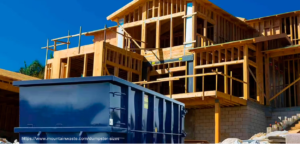
Zero Waste Washington has launched a new project to address how we manage construction and demolition (C&D) waste. The goal is to shift the industry to a more effective circular model with more salvage, reuse, and recycling. By analyzing current industry status, hurdles, best practices and opportunities, we plan to put together policy solutions to help keep valuable materials out of our landfills.
We are currently interviewing contractors, architects, builders, solid waste staff, processors/recyclers, researchers, suppliers, innovators, and others across Washington. We are gathering smart, sustainable ideas from these knowledgeable experts.
How much waste are we talking about
The scale of the challenge is significant. Nationally, C&D waste accounts for over 30% of the landfill load. In Washington, according to the WA State Department of Ecology, over 3 million tons of C&D waste were generated in 2023. King County’s 2024 C&D Characterization Study found that the most common items are roofing, wood, concrete, and gypsum (drywall). Other significant components include aggregates, insulation, and various packaging materials generated during the construction and renovation phase.
From insight to action
Working with key stakeholders, we are exploring strategies to optimize on-site operations and improve material management. After synthesizing the insights gathered from industry engagement, we will move into a convening phase to vet policy ideas. These events will build up to pilot activities in 2027 and a final recommendations report.
How you can help
We want to hear from you! A successful circular economy is a community effort. If you have contacts working in construction, demolition, deconstruction, salvage, recycling, research or related sectors in Washington, please let us know. We are looking for ideas and opinions from all corners of the sector to contribute to solutions that are practical and effective.
This project is funded in part by a Public Participation Grant from the Washington State Department of Ecology. Please contact Bengu at Bengu@zerowastewashington.org if you know a potential interviewee.
By Andrea Ramirez, Sustainability Analyst
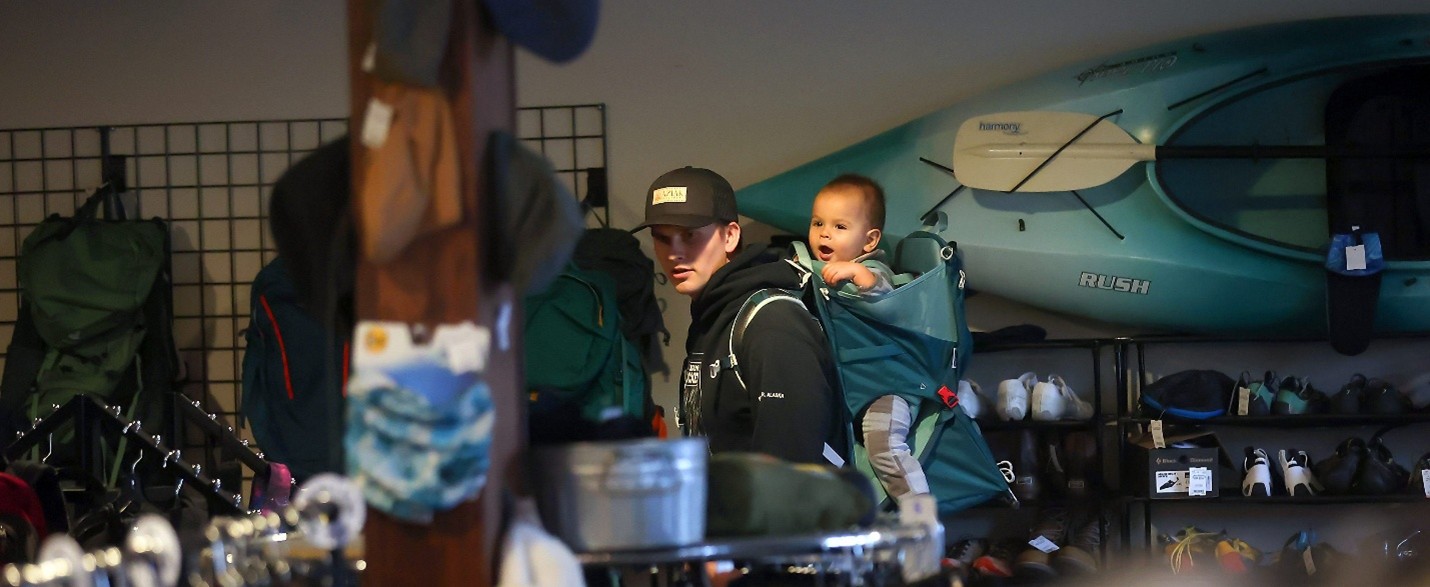
Spencer Evans and his baby at his new shop in Silverdale. All photos provided by Redeemed Recreation.
Whether you are a local or a visitor, Washington excels in offering countless opportunities to explore nature and enjoy outdoors activities. When the time comes to plan your outdoor adventures, you might realize that there is some gear, apparel or specific equipment that are required for certain activities and weather conditions. You might need a tent, a stove, maybe a rain jacket, hiking boots or a weekend backpack? Adding all these new items to your plan might sound like that camping trip to Mount Rainier will break your wallet, but not necessarily.
We interviewed Apryl Evans about her terrific new Silverdale outdoor gear consignment store (and see below for a listing of stores across the state).
New outdoor consignment store in Kitsap County
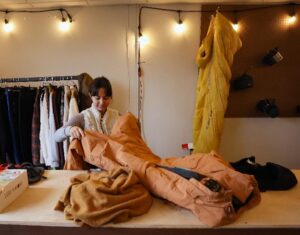 Apryl Evans and her husband Spencer, both being very active in rock climbing, snowboarding, skiing and other activities, were aware of the high cost of new outdoor gear and they wanted to offer an alternative to people of good quality items that still have life left, so they decided to start an outdoor gear consignment store in Silverdale, Washington, filling the gap of such shops in the area.
Redeemed Recreation, a 1500 square feet store, opened at the beginning of 2026, and in just a few months, the shop has received overwhelming support from the community, including customers from nearby areas like Bainbridge, Port Angeles, Gig Harbor and Tacoma.
The store stocks outdoor recreation gear and apparel that is clean, functional, and in good condition, with a significant portion being clothes, and popular items such as sleeping bags, backpacks, and winter gear. Additionally, some basic supplies for gear repair and maintenance are also available for purchase, patches, zippers, special lubricants and durable water repellents.
How does the consignment work?
Consignors bring the items to Redeem Recreation for staff to conduct an evaluation and price it based on condition, market value, brand, and demand. The standard consignment period is 90 days, and after this period, consignors have 10 days to pick up unsold items. When an item gets sold, sellers receive a tiered payout percentage of the final selling price, 60%-70%, which can be issued via direct deposit, or for an extra 5% you can opt for store credit.
Navigating the retail world and connecting communities
Starting Redeemed Recreation has been a journey with some challenges, continuous learnings but more importantly full of rewards. Apryl and Spencer are engineers by trade, so one of the big challenges has been learning about retail and business operations, keeping inventory updated and optimizing space while trying to organize the large number of items that people are bringing in.
Yet, for Apryl, this new project has brought an incredible opportunity to broaden her perspective of different communities in Kitsap, not only understanding what they enjoy when they go outside but also connecting to large groups like trail running and mountain biking communities in the area.
“I love that the store it’s becoming a place for different outdoor communities to come together” – Apryl Evans.
Apryl enjoys listening to the stories behind the items that people bring in, and she appreciates the fact that consignors trust them and want their gear to go to other people who are also going to use it.
“The best part of it is just meeting the community and meeting the people coming in. I love that consignment is kind of a community type business, because the people getting profit is the customer that brings stuff in…and people out in Kitsap that are bringing gear in, they really want to support us” – April Evans.
What is next?
As part of the upcoming plans for the store, Apryl and Spencer are aiming to expand gear rental options for customers, including backpacking, which provides the opportunity for people to use the gear for a few days or so, or just try it out and purchase it afterwards if they love it. Apryl said that rentals turn out to be very helpful to support different groups within the community, including high school students that she has connected with.
“If students want to just try out backpacking, then they don’t have to go and buy a bunch of stuff, they can rent the gear from us for a weekend and just to try it out.” – Apryl Evans.
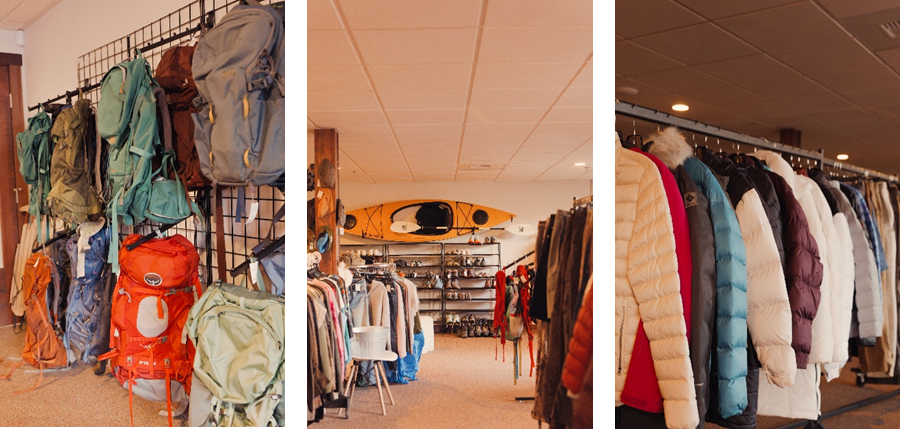 Apryl hopes for the store to keep growing, engaging with more people in the area, and potentially move to a bigger space where more large items can be stored, including bikes and kayaks. Stay tuned for more updates and upcoming events, visit Redeemed Recreation website, Instagram and if you can check it out in person (Address: 2819 NW Kitsap Pl, Silverdale WA. On Ridgetop Blvd)
Other second-hand outdoor gear stores in Seattle and across WA
Whether you are trying to give outdoor gear a second life or looking for something specific, there are many stores worth visiting with pre-owned recreation gear that might suit your needs:
- Wonderland Gear Exchange– Fremont
- Play it again Sports– South Lake Union, Lynwood, Bothell
- Superior Seconds– Issaquah
- MTN gear– Ravena – they also offer gear repairs, rent and 3-day Try Before You Buy.
- Mountain to sound Outfitters– West Seattle – Have an upcoming event – April 4th – Ski and Boat Swap –
- Ascent Outdoors– Interbay
- REI– Different locations across WA (Used section)
- The Evergreen Gear Exchange– Spokane
- Olympia Gear Exchange– Olympia
- Playback Sports– Tacoma
- Backcountry Essentials – Bellingham
- Madrona Wear – Bellingham
- Marine Thrift – Port Townsend
- Play it again Sports – Vancouver
- Das Thrift Haus – Leavenworth
- Colchuck Consignment – Cashmere
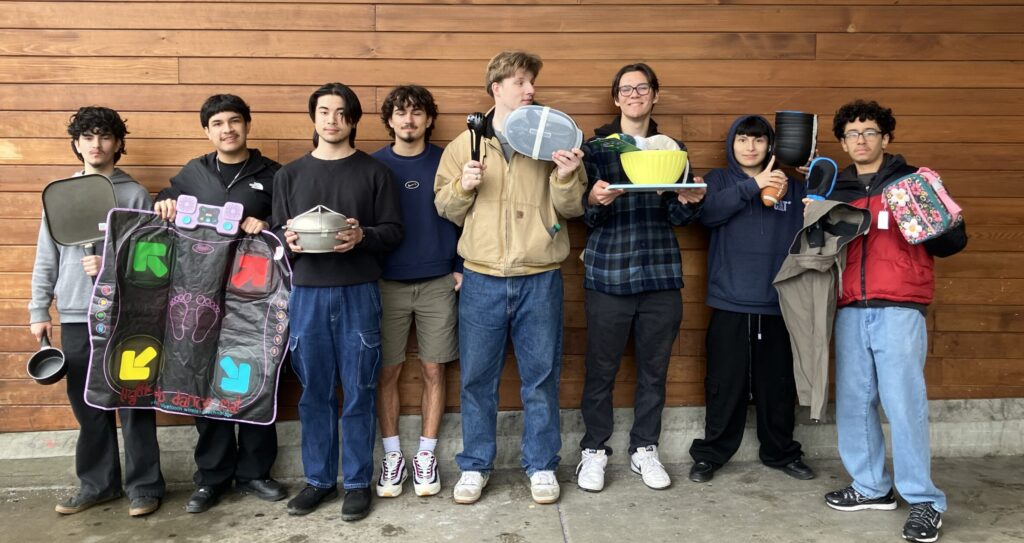
Duwamish Valley Youth Corps Cadets zero waste interns, after an investigative trip to a local thrift store (identifying products that might contain toxic chemicals).
By Nayeli Campos, Community Outreach and Policy Coordinator
Zero Waste Washington, along with partners, is conducting a multi-year project to encourage the public to replace household products that contain toxic chemicals with safer alternatives. Think cookware that is contaminated with lead. Or pots, pans and small appliances with non-stick coatings which contain PFAs. Fishing gear with lead weights. Plastic cutting boards and plastic utensils that shed nano- and micro-plastics into food.
The project, funded by the US EPA via the Washington State Department of Ecology, includes product research, messaging testing, educational outreach to the public, and educational outreach to thrift shops (to not accept certain items for donation).
Swap Events
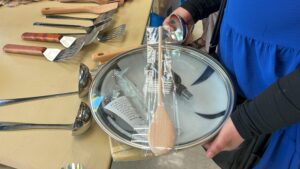
Swap event: wood utensils to replace plastic items and PFAS- and lead-free frying pans to replace older nonstick pans.
A key component of the project is pass-through funding, up to $50K each, for local jurisdictions in Snohomish, Kitsap, Pierce, and King counties to conduct public swap-out events.
These events give residents a chance to trade in their old, toxic pots and pans, plastic kitchenware, fishing gear, etc. for high-quality, safer alternatives such as stainless steel cookware or lead-free fishing gear.
At some of these events, there will be the opportunity for community members to have pots and pans tested for lead.
Applications accepted on a rolling basis
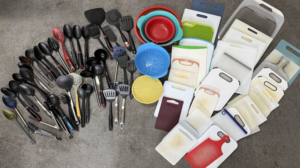
Old plastic items collected at swap events.
At this time, we have applications available for local public jurisdictions (cities, counties, public health districts, etc.) in Snohomish, Kitsap, Pierce and King Counties to apply for swap-out event funding.
Applications are being accepted on a rolling basis until funding expires. Approved funds can cover events and activities scheduled all the way through December 2027.
Whether a jurisdiction wants to host a one-day swap-out event, or a series of targeted neighborhood workshops, we want to help make it happen!
If you know of a jurisdiction that might be interested, please contact Nayeli at nayeli@zerowastewashington.org
GiveBIG 2026 will officially kick off on April 28 and culminate in a 24-hour giving event on May 5, 2026.
Zero Waste Washington’s commitment to tackle the toughest waste, recycling, plastics, toxic chemicals and consumption issues is stronger than ever. Together with all of our members and partners, we work tirelessly to drive policy change for a healthy and waste-free world. You can help us reach our goals in 2026 and beyond!
Zero Waste Washington’s work is more important than ever, and we greatly appreciate your support.
Click this link to donate through GiveBIG: https://www.wagives.org/organization/zero-waste-washington-1
Thank you for your gift.
Our end-of-year campaign has launched! Please join Zero Waste Washington and support us with your tax deductible gift.
Did someone forward this newsletter to you? Please sign yourself up here
Check out our 2025 Year in Review here
And could you support us with your tax-deductible gift? Your gift enables us to continue making Washington State’s waterways, communities, and the air we breathe healthy and waste free.
Please join this effort and donate today!
Zero Waste Washington cannot do this work without you. Thanks for joining us!
Donate here
Zero Waste Washington
PO Box 84817 * Seattle, WA * 98124
(206) 441-1790
